
Salsa timing is defined as the placement of your dance steps within an 8-beat musical cycle, specifically stepping on beats 1, 2, 3, then pausing on beat 4, stepping on beats 5, 6, 7, and pausing on beat 8. Most beginners struggle not because the steps are hard, but because they step on every beat instead of honoring those two intentional pauses. The industry recognizes two primary timing styles, On1 and On2, both built on this same 8-count foundation. Mastering salsa timing explained here gives you the rhythmic base for every move you will ever learn.
What is the basic rhythmic structure of salsa timing?
Salsa music is counted in eight beats, but dancers only step on six of them. The pattern is 1-2-3, hold on 4, then 5-6-7, hold on 8. That creates a quick-quick-slow rhythm that repeats twice every musical phrase.
The holds on beats 4 and 8 are not rests. The pause settles your weight and keeps you balanced before the next set of steps begins. Rushing through those holds is the single most common reason beginners look mechanical on the floor.
Weight transfer is the physical engine behind the count. Every time you step, your full body weight shifts onto that foot. Incomplete weight shifts create balance problems and make your hips look stiff. The count gives you the when, and the weight transfer gives you the how.
| Count | Action | Feel |
|---|---|---|
| 1 | Step forward or back (break step) | Quick |
| 2 | Step to the side | Quick |
| 3 | Bring feet together or close | Slow |
| 4 | Hold, settle weight | Pause |
| 5 | Step forward or back (break step) | Quick |
| 6 | Step to the side | Quick |
| 7 | Bring feet together or close | Slow |
| 8 | Hold, settle weight | Pause |
Pro Tip: March in place while counting 1 through 8 out loud. Lift your foot on 1, 2, 3, freeze on 4, lift again on 5, 6, 7, and freeze on 8. Doing this for two minutes before class locks the pattern into your body before the music starts.
How do On1 and On2 salsa timing styles differ?
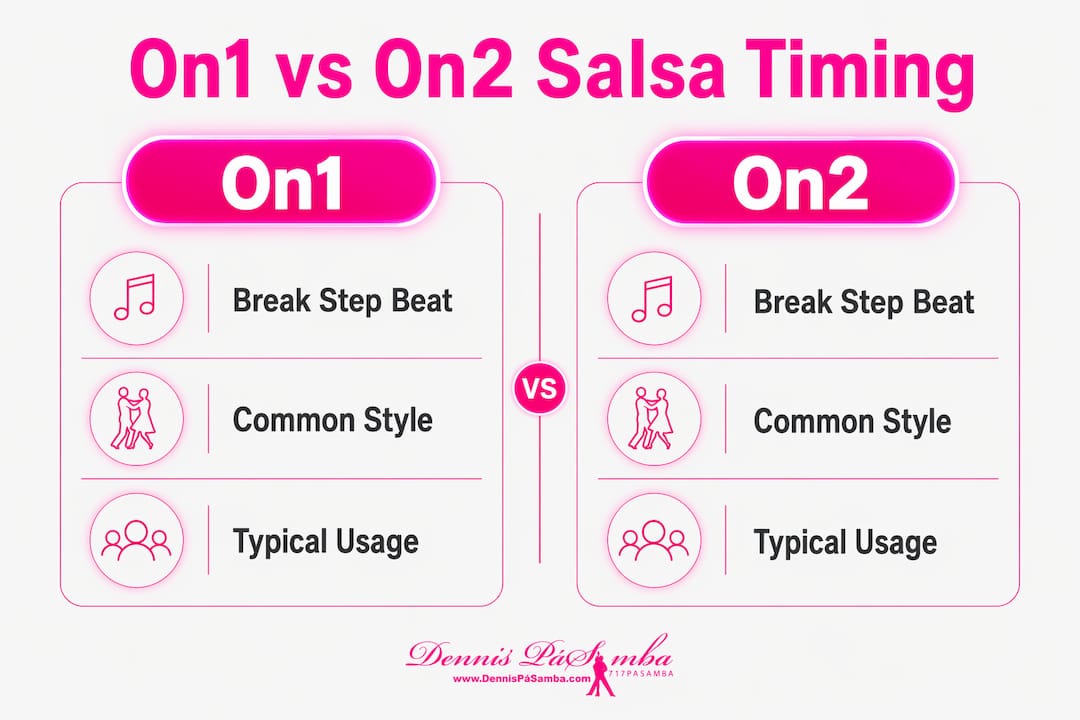
On1 and On2 describe where your break step lands within the 8-count phrase. On1 timing places the break step on beat 1, while On2 timing places it on beat 2. The rest of the step pattern stays exactly the same for both styles.
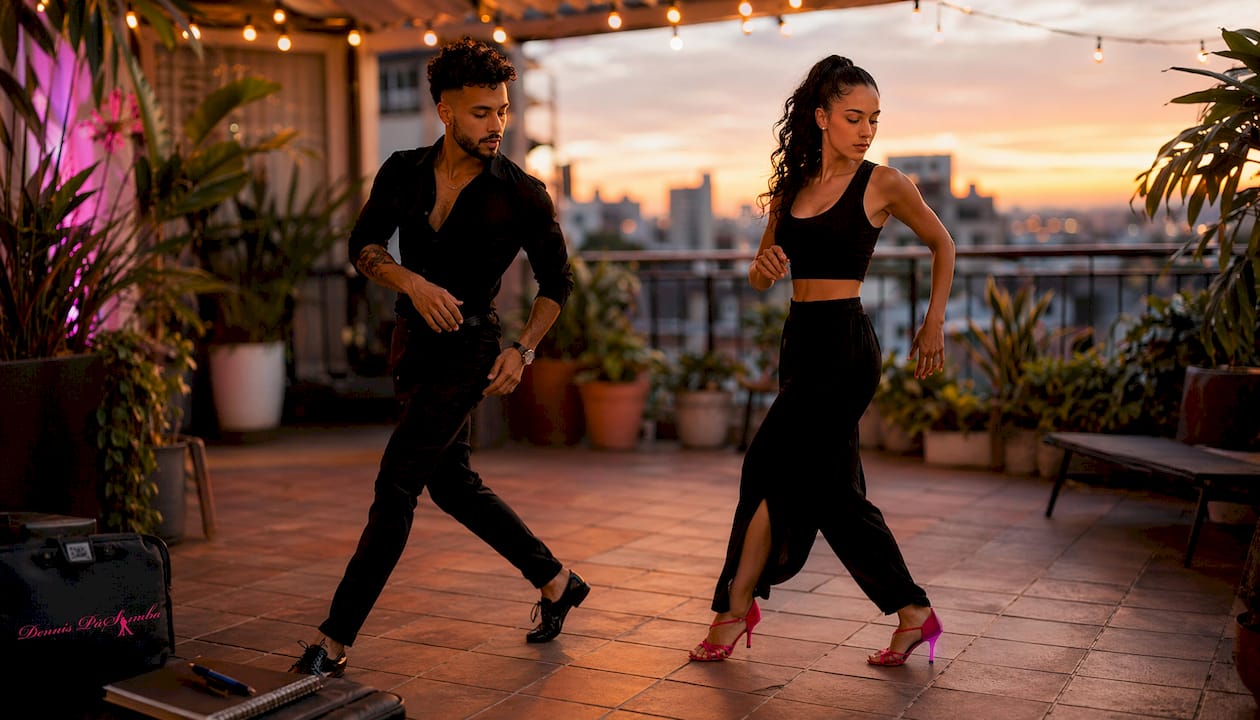
On1 is the standard starting point for most beginner classes, including the LA style popular across the United States. On2 is closely tied to New York style and carries a strong mambo influence. On2 dancers often describe the feel as “deeper” because the break lands on the conga slap rather than the downbeat.
| Feature | On1 | On2 |
|---|---|---|
| Break step beat | Beat 1 | Beat 2 |
| Common style | LA style | NY style / Mambo |
| Typical setting | Beginner classes | Intermediate and social |
| Rhythmic feel | Hits the downbeat | Hits the conga slap |
| Best for beginners | Yes | After On1 is solid |
Choosing between them is simple at the start. Consistency in one style builds musicality faster than switching back and forth. Pick On1, get comfortable, and then explore On2 once the basic rhythm feels automatic.
Key points to remember about timing styles:
- Both On1 and On2 use the same 1-2-3, hold, 5-6-7, hold structure.
- The style only changes which beat triggers your first break step.
- Your local dance scene often determines which style is most practical to learn.
- Mixing styles mid-song confuses partners and breaks connection.
How can beginners train their ears to find the salsa beat?
Salsa’s layered percussion is the reason beginners feel lost when the music starts. You hear melody, brass, piano, and vocals all at once. The beat gets buried unless you know what to listen for.
The conga drum is your anchor. The conga’s open tone lands on beats 1 and 5, and the slap sound lands on beats 2 and 6. Once you can hear those two sounds separately, finding your place in the music becomes much easier. This technique is sometimes called the Beat Lock Method, and it works because it gives you a single instrument to track instead of the whole band.
Finding beat 1 takes a little extra practice. Listen for the brief pause after beat 8. That moment of space in the music is where the new phrase begins. Beat 1 follows that pause every time, without exception.
Here is a step-by-step listening practice to build your ear:
- Play a salsa track and close your eyes. Ignore the melody and vocals completely.
- Listen only for the drum sounds. Find the lowest, most resonant hit. That is your conga open tone.
- Notice the sharper, higher slap that follows shortly after. That is the conga slap on beat 2.
- Clap along with the open tone only. You are now clapping on beats 1 and 5.
- Add a soft clap on the slap sound. You are now marking beats 1, 2, 5, and 6.
- Feel where the silence falls. That silence is beats 4 and 8.
- Start stepping in place to match your claps. You are now dancing on the beat.
Pro Tip: Turn off the vocals on a familiar salsa track if your music app allows it, or search for “salsa percussion only” tracks online. Removing the melody forces your ear to lock onto the drum pattern within minutes.
What are common salsa timing mistakes and how do you fix them?
Most timing problems come down to a few repeatable errors. Knowing what they are makes them much easier to correct.
Common mistakes:
- Stepping on all 8 beats instead of 6, which eliminates the pauses entirely.
- Starting on the wrong beat, usually beat 2 or 3 instead of beat 1.
- Rushing through the hold on beat 4 or 8 because the pause feels unnatural.
- Taking large steps that throw off balance and make weight transfers slow.
- Counting words (“one, two, three”) instead of feeling the rhythm physically.
Simple fixes:
- Clap the basic rhythm before stepping. Clap on 1, 2, 3, pause, 5, 6, 7, pause. Your hands teach your feet.
- Use the Beat Lock Method to find beat 1 before you start moving. Never step until you hear that first conga open tone.
- Keep your steps small and close to the floor. Small steps allow faster, cleaner weight transfers and keep you “in the pocket” of the music.
- Focus on weight transfer over footwork. Ask yourself, “Did my full weight move?” after every step.
- Practice the basic salsa step without music first. Count out loud, feel the holds, and add music only when the pattern feels natural.
The most overlooked fix is slowing down. Beginners often try to match the tempo of a fast song before the pattern is automatic. Start with slow or mid-tempo salsa tracks. Speed follows accuracy, not the other way around.
How does mastering salsa timing improve your dancing overall?
Good timing is the foundation that every other skill builds on. Timing is the framework for weight transfers, and clean weight transfers produce natural hip movement, better balance, and fluid styling. Without timing, spins wobble, turns arrive late, and your body fights the music instead of riding it.
Partner connection depends directly on timing. When both dancers share the same count, leads and follows become effortless. The leader’s weight shift signals the next move, and the follower reads that signal because it arrives exactly when expected. Off-timing dancers miss those signals entirely, which makes every move feel forced.
Timing also makes you adaptable. A dancer who owns the 8-count pattern can adjust to fast tempos, slow tempos, and different partners without losing the beat. That adaptability is what separates confident social dancers from beginners who can only dance to one tempo. Check out the salsa social dancing guide for more on building that confidence on a real dance floor.
Pro Tip: Record yourself dancing for 30 seconds and watch it back with the music muted. If your steps look uneven or rushed, your timing is off. Muting the music removes the emotional pull of the song and lets you see the rhythm objectively.
Key Takeaways
Salsa timing requires stepping on beats 1, 2, 3 and 5, 6, 7, holding on beats 4 and 8, and fully transferring your weight on every step to stay balanced and musical.
| Point | Details |
|---|---|
| 8-count step pattern | Step on 1-2-3 and 5-6-7; hold on beats 4 and 8 every phrase. |
| On1 vs. On2 | Both use the same pattern; On1 breaks on beat 1 and is best for beginners. |
| Conga drum anchor | Track the conga open tone and slap to find and keep the beat reliably. |
| Small steps win | Keeping steps small and close to the floor improves weight transfer and timing. |
| One style first | Mastering one timing style before switching builds musicality faster. |
What 33 years of teaching salsa timing taught me
Most beginners think timing is about counting. It is not. Counting is just a training wheel. The real goal is to feel the pause on beat 4 as a moment of calm, not a gap you need to fill. Every student I have worked with who struggled with timing was rushing that hold. They were so eager to get to the next step that they skipped the most important beat in the phrase.
The other thing I see constantly is beginners listening to the wrong part of the music. They follow the piano or the singer, and both of those instruments play freely around the beat. The conga drum does not. It is the clock of the song. Once a student learns to hear that drum, timing clicks within a single class session. That is not an exaggeration.
My honest advice: do not worry about On1 versus On2 for the first month. Pick one, stay with it, and focus entirely on clean weight transfers and honoring those holds. The style debate is a distraction when the basic pattern is not yet automatic. Patience with the fundamentals pays off faster than chasing advanced material.
Timing also makes dancing more fun. When you are on the beat, the music carries you. When you are off the beat, you are fighting it. That difference in feeling is what keeps people coming back to the floor for decades.
— Dennis pasamba
Ready to feel the beat at Dennis pasamba?
Learning salsa timing is much faster with a great instructor and a room full of energy behind you. At Dennis pasamba, beginner salsa classes in Chicago are built around exactly what you read here: the 8-count pattern, weight transfer, and ear training for the conga beat. Classes include partner rotation so you practice with multiple people and build real timing confidence.
No partner needed. No experience required. Dennis pasamba has earned 850+ five-star Google reviews by making beginners feel welcome and capable from day one. If you want to know what to look for in a studio before you sign up, the dance studio checklist is a great place to start. Come feel the difference that real timing instruction makes.
FAQ
What beats do you step on in salsa?
Salsa dancers step on beats 1, 2, 3 and 5, 6, 7, with intentional pauses on beats 4 and 8. Steps only land on six of the eight counts in every musical phrase.
What is the difference between On1 and On2 salsa timing?
On1 places the break step on beat 1 and is standard in beginner and LA style classes. On2 places the break step on beat 2 and is associated with New York style and mambo.
How do I find the beat in salsa music?
Listen for the conga drum and ignore the melody. The open tone marks beats 1 and 5, and the slap marks beats 2 and 6. Tracking those two sounds anchors you to the rhythm reliably.
Why do beginners struggle with salsa timing?
Beginners typically step on all 8 beats and skip the holds, or they listen to the melody instead of the percussion. Both errors break the quick-quick-slow pattern that salsa timing requires.
How long does it take to get salsa timing right?
Four consecutive weeks of practice moves most beginners from feeling lost to basic timing proficiency. Consistent repetition, not natural talent, is what builds timing confidence.