
A dance community is defined as a participatory social group where people connect, express themselves, and build belonging through shared movement and cultural experiences. This is the standard definition used by organizations like the Community Dance Foundation, which describes community dance as primarily social and participatory rather than performance-focused. The concept covers everything from Salsa classes and Bachata socials to festival dances and informal studio gatherings. Research confirms that adults who join these groups gain measurable social, emotional, and mental health benefits. Dennis pasamba, Chicago’s top-rated Latin dance studio, sees this play out every week across beginner classes, Friday socials, and group workshops.
What is a dance community, and why does it matter?
A dance community is any group of people who gather regularly around shared dance activities, with connection and participation as the primary goals. The term “community dance” is the recognized industry phrase for this concept. It covers a wide range of settings, from neighborhood studios and cultural festivals to church halls and public parks.
The importance of a dance community goes beyond learning steps. Structured dance programs produce measurable gains in social competence, with dancers scoring an average of 75 on social competence measures compared to 70 for non-participants. That five-point gap reflects a real, consistent difference in how people relate to others. Adults in dance groups report stronger empathy, better communication, and a greater sense of belonging than those who stay on the sidelines.
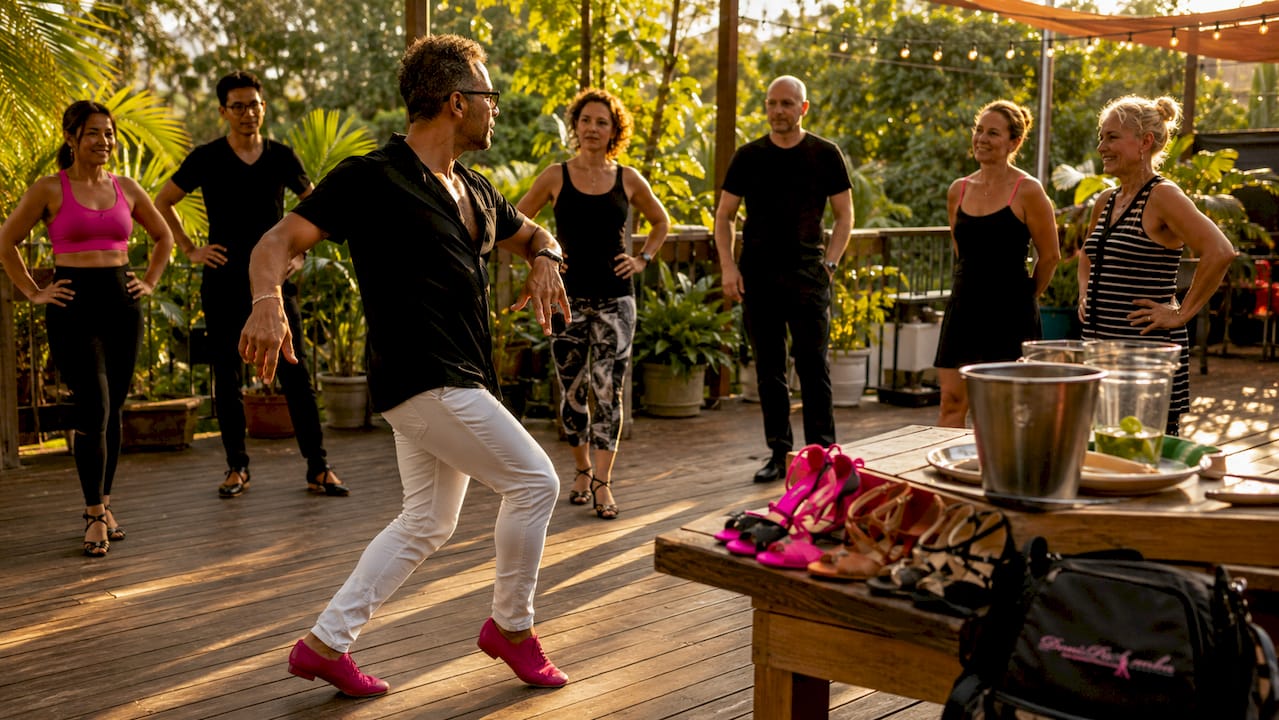
Community dance also differs from recreational or competitive dance in one key way. The goal is access and engagement, not technical perfection or stage performance. That distinction makes it genuinely open to everyone, regardless of age, background, or experience level.
How does dance build and nurture community?
The social bonding that happens in dance groups is not accidental. It has a neurological basis. Moving in synchrony creates a process called co-representation, where the brain begins to blur the boundary between self and other. This increases empathy and trust between dancers at a biological level. You feel closer to the people you move with because your brain is literally processing their movements as part of your own experience.
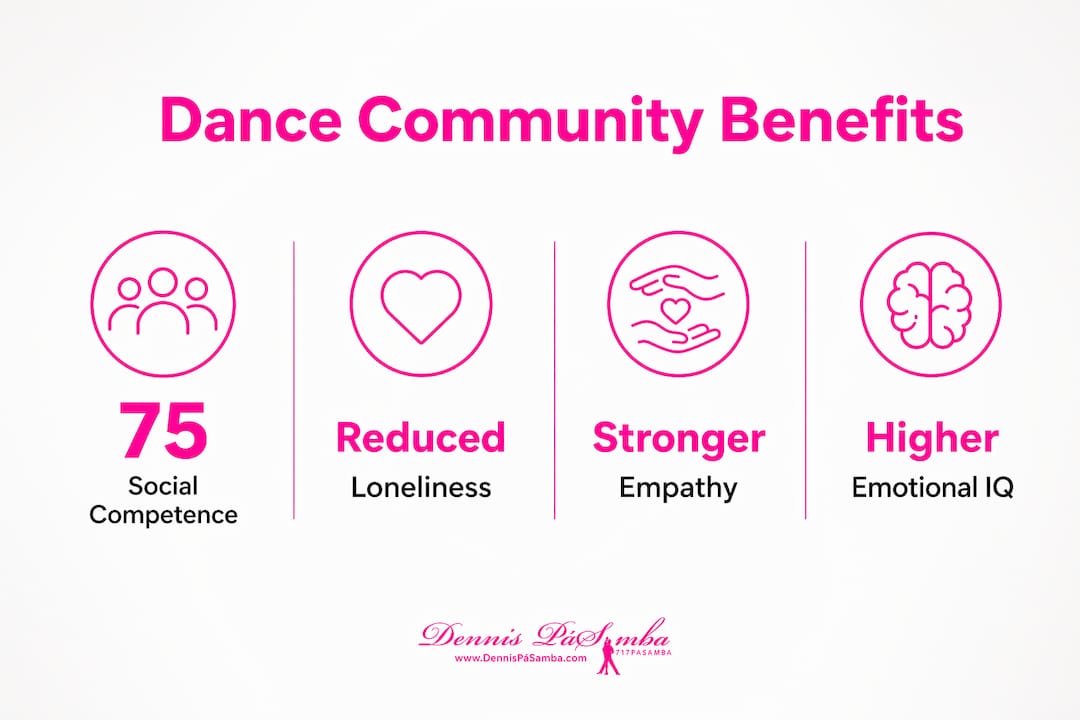
Group dancing at festivals and socials produces even stronger effects. Participating in group dances at festivals lowers loneliness and increases a sense of community significantly more than simply attending without dancing. The act of moving together is what creates the bond, not just being in the same room.
Dance studios function as what researchers call knowledge communities. Shared in-studio learning creates social bonds that go well beyond technique. Students co-create understanding, support each other through challenges, and form relationships that reduce isolation. This is why a good studio feels like a second home after just a few weeks.
“Community dance prioritizes access and social engagement rather than performance, offering motion as a relational practice. The goal is not to produce dancers but to produce connection.”
Participatory dance differs from performance-focused dance in one critical way. Performance dance centers on the audience’s experience. Community dance centers on the participant’s experience. That shift changes everything about how people show up, how they relate to each other, and what they take home.
- Synchrony builds trust. Moving together activates co-representation in the brain, increasing empathy between participants.
- Repetition deepens bonds. Sustained participation is the key factor in forming lasting social connections within dance groups.
- Shared learning reduces isolation. Studios that prioritize co-learning create environments where students feel seen and supported.
- Participation beats observation. Watching dance does not produce the same social benefits as actively joining in.
Pro Tip: Arrive five minutes early and stay five minutes after class. Pre- and post-class conversations are where the real community bonds form, not on the dance floor.
What forms and activities make up a dance community?
Community dance takes place in accessible, everyday spaces. Venues include community centers, parks, studios, faith spaces, and cultural halls. The setting matters because it signals who belongs. A neighborhood studio or a park gathering sends a very different message than a professional theater stage.
The activities within a dance community are equally varied. Here is a breakdown of the most common formats:
- Weekly classes: Structured learning sessions open to all skill levels, covering styles like Salsa, Bachata, Cumbia, Kizomba, and Cha-Cha.
- Social dances: Informal events where participants dance freely with multiple partners, building confidence and connection. Chicago’s Friday night dance socials are a strong example of this format.
- Workshops and intensives: Focused sessions on specific styles or techniques, often bringing in guest instructors.
- Cultural festivals: Large gatherings where dance is embedded in broader cultural celebration, amplifying the sense of shared identity.
- Collaborative projects: Group performances, showcases, or community presentations where participants work toward a shared creative goal.
The table below shows how community dance compares to professional or studio performance dance across key dimensions.
| Dimension | Community dance | Performance-focused dance |
|---|---|---|
| Primary goal | Participation and connection | Technical excellence and performance |
| Skill requirement | None. All levels welcome | Often requires auditions or prerequisites |
| Setting | Accessible community spaces | Studios, theaters, competition venues |
| Success measure | Engagement and belonging | Scores, reviews, or audience response |
| Who it serves | Everyone | Trained or aspiring professionals |
Community dance is not therapy, and that distinction matters. It provides grounding, support, and social connection through movement, but it operates as a relational and cultural practice, not a clinical one. Adults who join for fun, fitness, or friendship get those things. The social and emotional benefits arrive as a natural result of participation.
Why is being part of a dance community important for adults?
Adults face a specific set of social challenges that dance communities address directly. Loneliness, reduced social networks after major life transitions, and limited opportunities for creative expression all increase with age. Dance communities counter all three.
The social competence gains from structured dance are consistent and well-documented. Dancers score higher on social competence measures than non-participants, with a smaller standard deviation in the dance group. That smaller spread means the benefits are reliable, not just occasional. Most adults who join a dance community see real improvement in how they connect with others.
The emotional benefits are equally strong. Dance builds empathy, self-agency, and emotional intelligence through repeated creative and physical engagement. Adults who learn dance together report increased motivation, personal growth, and a stronger sense of purpose. These outcomes go well beyond what most fitness or hobby activities deliver.
| Benefit | What the research shows |
|---|---|
| Social competence | Dancers score an average of 75 vs. 70 for non-participants |
| Loneliness reduction | Group dancing at festivals produces statistically significant drops in loneliness |
| Empathy and trust | Synchronous movement creates neurological co-representation |
| Motivation and growth | Shared in-studio learning enhances personal development beyond technique |
| Sense of belonging | Sustained participation is the primary driver of lasting social bonds |
Adults who want to understand why Latin dance is gaining popularity will find that the social pull is a major factor. Styles like Salsa and Bachata are built around partner connection and group energy, which makes them especially effective at generating the community bonds described above.
Pro Tip: If you feel nervous about your skill level, remember that community dance is not about being good. It is about showing up. The social benefits start on your first night, not after you master the footwork.
How can you join or become involved in a dance community?
Finding the right dance community starts with identifying what you actually want from it. Some adults want structured learning. Others want a social outlet. Many want both. Your answer shapes which type of group fits you best.
- Choose a style that excites you. Salsa, Bachata, Cumbia, Swing, Tango, and Ballroom each carry their own social culture. Try a beginner class in two or three styles before committing. Dennis pasamba offers all of these under one roof, which makes sampling easy.
- Find local classes and socials. Search for dance groups near you that offer open social nights alongside structured classes. Social events are where community bonds form fastest.
- Show up consistently. Repeated participation is the single most important factor in building lasting connections. One class a week for a month will do more for your social life than ten classes in a single weekend.
- Engage before and after class. The conversations in the lobby, the post-class coffee, and the group chat are all part of the community. Treat the studio as a social ecosystem, not just a classroom.
- Contribute beyond dancing. Volunteer to help at events, welcome newcomers, or join a performance showcase. The adults who feel most connected are the ones who give back to the group.
Pro Tip: No partner? No problem. The best dance communities are built around rotating partners and open social floors. Singles often build stronger community ties than couples because they interact with more people each session.
Key Takeaways
A dance community is a participatory social group where shared movement builds empathy, trust, and belonging, with research confirming measurable gains in social competence and loneliness reduction for consistent participants.
| Point | Details |
|---|---|
| Core definition | A dance community centers on participation and connection, not performance or technical skill. |
| Social competence gains | Dancers score an average of 75 vs. 70 for non-participants on social competence measures. |
| Neurological bonding | Synchronous movement creates co-representation in the brain, increasing empathy and trust. |
| Consistent participation | Repeated attendance is the primary driver of lasting social bonds within any dance group. |
| Accessible to all | Community dance welcomes all skill levels, backgrounds, and ages, with no partner required. |
What 33 years on the dance floor taught me about community
Most people walk into a dance studio thinking the point is to learn steps. After more than three decades teaching Salsa, Bachata, Cumbia, and a dozen other styles in Chicago, I can tell you the steps are almost beside the point. What people are really looking for is a place where they belong.
The biggest misconception I see is that you need to be good before you can be part of the community. That gets it exactly backward. The community is what makes you good. When you feel safe, supported, and connected to the people around you, you learn faster, take more risks, and stay longer. The technical skills follow naturally from the social environment.
I have watched shy adults walk through the door alone and leave six months later with a full social circle. I have seen people come in grieving, burned out, or just bored, and find something they did not know they were missing. That is not magic. It is what happens when you put people in a room, give them a shared rhythm, and let them move together.
The advice I give every newcomer is simple: stop worrying about your feet and start paying attention to the people. Introduce yourself. Ask someone to dance. Stay for the social after class. The friendships you build at a dance studio are often the most genuine ones in your life, because they start with joy instead of obligation.
— Dennis pasamba
Ready to find your dance community in Chicago?
Chicago has one of the most vibrant Latin dance scenes in the country, and Dennis pasamba sits at the center of it. With over 850 five-star Google reviews and 33 years of experience, the studio offers beginner classes, Friday night socials, private lessons, and group workshops across Salsa, Bachata, Cumbia, Kizomba, and more.
No partner needed. No experience required. Whether you want to try your first class or find your next social dance night, Dennis pasamba has a format that fits. Check out the beginner Latin dance classes to see what your first night looks like, or browse the new Salsa, Bachata, and Cumbia classes starting now in Chicago. Your community is already there. You just have to show up.
FAQ
What is the dance community definition?
A dance community is a participatory social group that gathers around shared dance activities, prioritizing connection and belonging over performance. The term “community dance” is the recognized industry phrase for this practice.
What are the main benefits of dance communities for adults?
Adults in dance communities gain measurable improvements in social competence, reduced loneliness, stronger empathy, and greater emotional wellbeing through consistent participation and shared movement.
How do I find dance groups near me?
Start by searching for local studios that offer both structured classes and open social nights. Attending a social event alongside a class gives you the fastest path into an active dance community.
What makes a dance community different from a dance class?
A dance class focuses on skill instruction. A dance community includes the social relationships, shared culture, and ongoing connection that form around those classes, socials, festivals, and collaborative events.
Do I need a partner to join a dance community?
No partner is needed. The best dance communities rotate partners and welcome singles and couples equally. Rotating partners actually accelerates social bonding because you interact with more people in each session.