
Cuban salsa, formally known as Casino, is a circular partner dance born in 1950s Havana that moves in rotating patterns rather than a straight line. If you’ve ever wondered what is Cuban salsa and why it feels so different from what you see in clubs or on TV, the answer lives in its roots. Casino grew from Afro-Cuban music, street culture, and social gatherings, not from stage performance. It is improvisational, grounded, and deeply communal. Understanding it means understanding a living piece of Cuban culture, not just a set of steps.
What is Cuban salsa and where did it come from?
Cuban salsa originated in Havana’s social clubs in the 1950s, specifically in gathering spaces called Casinos Deportivos. These were community clubs where working-class Cubans danced, socialized, and created something entirely their own. The dance that emerged there became known as Casino, the authentic Cuban name for what the world now calls Cuban salsa.
Casino did not appear from a single source. It pulled from several existing Cuban and Afro-Cuban traditions:
- Son cubano: The rhythmic backbone of Cuban popular music, blending Spanish guitar with African percussion.
- Mambo: A faster, more energetic style that added dramatic flair and complex footwork.
- Cha-Cha-Chá: A lighter, playful rhythm that contributed syncopated step patterns.
- Afro-Cuban rumba: Street and ceremonial dance rooted in Yoruba traditions, contributing hip isolations, grounded posture, and improvisational call-and-response.
- Orisha dance: Ritual movement tied to Afro-Cuban spiritual traditions, which shaped the expressive, full-body quality of Casino’s movement vocabulary.
Each of these influences left a clear mark. The bent knees, the hip movement, the way a dancer responds to a musical break rather than ignoring it. These are not stylistic choices. They are cultural inheritances. Experts highlight that Casino’s authentic identity as a circle-based social dance is often lost when it gets marketed globally under the generic label of “salsa.”
How does Cuban salsa music shape the dance?
Cuban salsa is primarily danced to Timba, a genre that fuses Afro-Cuban rhythms with funk, jazz, and electronic elements. Timba is not background music. It is a conversation partner. Artists like Los Van Van, Maykel Blanco y Su Salsa Mayor, and Manolito Simonet y Su Trabuco built Timba into one of the most rhythmically demanding genres in Latin music.
What makes Timba different from the salsa music you hear in most clubs:
- Unpredictable breaks: Timba drops the beat without warning, demanding that dancers stay grounded and attentive rather than coasting on autopilot.
- Percussion shifts: The clave, congas, and timbales change texture mid-song, giving dancers cues to shift their movement quality.
- Vocal improvisation: Singers call out phrases that dancers can respond to physically, creating a three-way conversation between music, leader, and follower.
- Groove over structure: Timba prioritizes rhythmic feel over predictable phrasing, which is why Cuban salsa dancers look so free compared to dancers in other styles.
This contrasts sharply with salsa romántica or salsa dura, the smoother, more predictable genres that LA and New York style dancers typically use. Those genres reward polished technique and clean timing. Timba rewards listening and adaptability.
Pro Tip: When you first practice Cuban salsa, listen to Timba for 10 minutes before you touch the floor. Let the rhythm settle into your body before you try to count steps.
What are the key movements and techniques in Cuban salsa?
The circular movement pattern is the single most defining feature of Casino. Partners rotate around a shared center point rather than traveling up and down a slot. This geometry changes everything about how you lead, follow, and connect.
Here are the core techniques every Cuban salsa dancer builds on:
- Guapea: The basic step. Partners rock back and forth in a relaxed, conversational rhythm. It is the resting position between moves and the foundation of all Casino timing.
- Dile que no: Literally “tell her no.” This is the fundamental redirecting move that resets the circular path and keeps partners rotating around each other.
- Enchufla: A turn pattern where the leader redirects the follower into a new position. It is the most common building block for combinations.
- Vacilala: A playful move where the follower turns freely while the leader steps back and “watches.” It reflects Casino’s improvisational, non-controlling lead style.
- Rueda de Casino: A group circle format where multiple couples dance together and swap partners on calls from a designated caller. Rueda requires collective listening and real-time responsiveness, making it one of the most socially engaging formats in any partner dance.
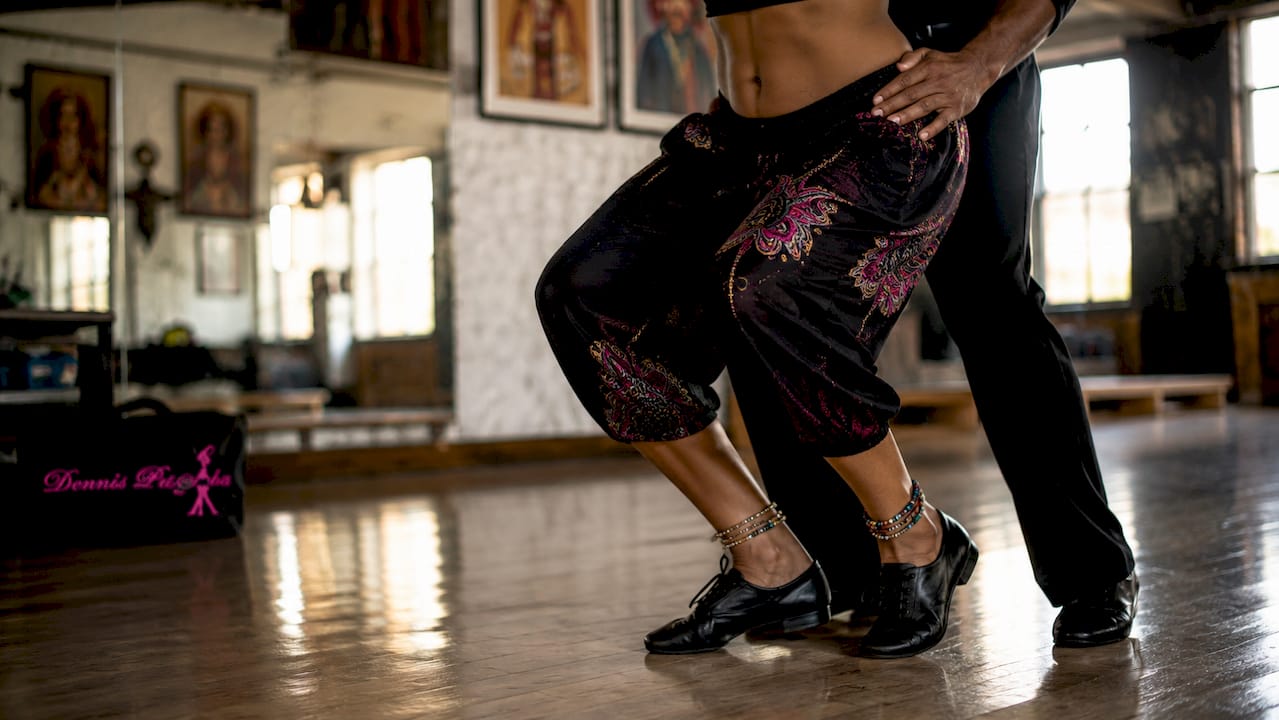
The body movement in Casino comes directly from Afro-Cuban tradition. Bent knees, torso isolations, and hip movement are not decorative. They are how the body absorbs and expresses the rhythm. LA and NY style dancers often stand taller and move more linearly. Casino dancers stay low, loose, and connected to the floor.
Pro Tip: Do not try to “style” your hips in Cuban salsa. Instead, bend your knees and let the hip movement happen naturally as your weight shifts. Forced hip movement looks stiff. Relaxed knees create the real thing.
How does Cuban salsa differ from LA and New York style?
The difference between Cuban salsa and linear styles is not just aesthetic. It is structural.
| Feature | Cuban salsa (Casino) | Linear salsa (LA / NY style) |
|---|---|---|
| Movement path | Circular, rotating around a shared center | Straight slot or line |
| Music | Timba, Afro-Cuban fusion with unpredictable breaks | Salsa romántica or salsa dura with steady rhythm |
| Body movement | Grounded, bent knees, hip and torso isolations | Upright posture, emphasis on turns and footwork |
| Lead style | Conversational, improvisational, rotational | Declarative, choreographed, cross-body leads |
| Social format | Community-focused, includes Rueda de Casino | Performance-oriented, partner-focused |
| Timing | Flexible, governed by circular geometry | Fixed On1 (LA) or On2 (NY) counting |
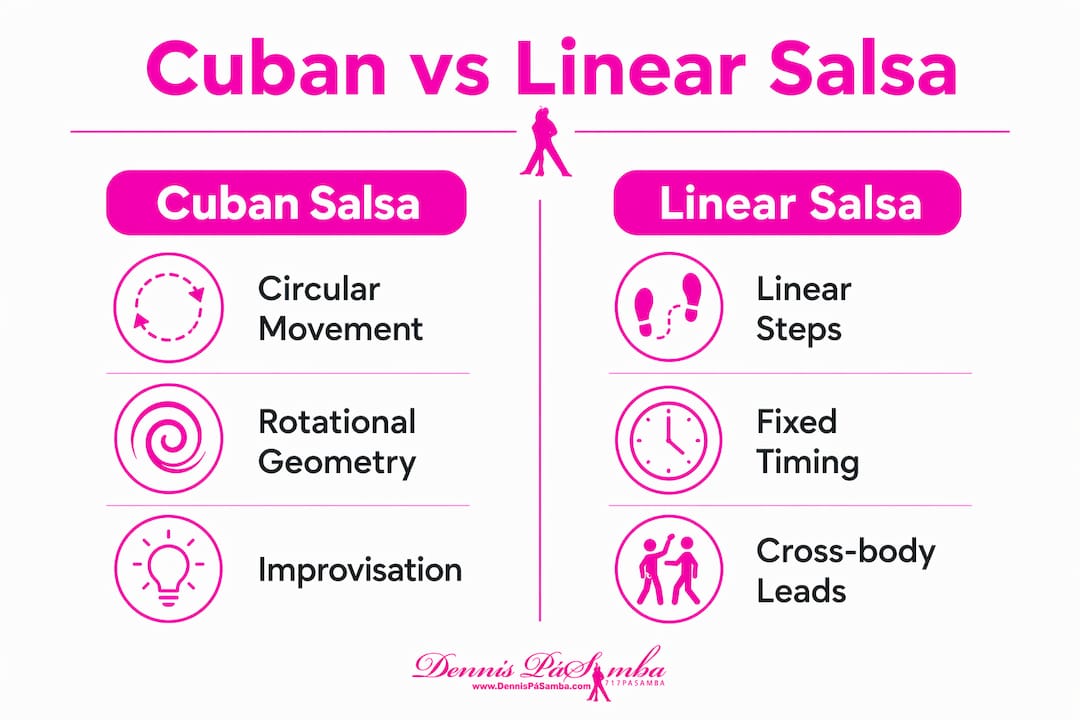
Linear salsa focuses on cross-body leads and fixed timing, while Casino relies on rotational geometry and improvisation. This is not a small difference. It means a dancer trained only in LA style will feel genuinely lost on a Casino floor, and vice versa.
The social atmosphere also differs. Cuban salsa events feel like community gatherings. LA and NY events often feel more like showcases where technique is on display. Neither is better. They serve different needs and reflect different cultural values.
How do you start learning Cuban salsa?
Beginners often confuse salsa as a single dance. The first step is accepting that Casino is its own language, not a variation of what you may have seen in a club. Here is how to approach it well:
- Start with the basic step (Guapea) before anything else. Get comfortable with the rocking rhythm and the circular weight shift. Everything else builds from there.
- Listen to Timba music outside of class. The more familiar the music feels, the more natural your movement will become. Check out Los Van Van as a starting point.
- Embrace the conversation. Casino is an improvisational partner dialogue, not a sequence of memorized moves. Your goal is to respond, not to perform.
- Try Rueda de Casino early. It feels intimidating, but Rueda’s group format is actually forgiving. Everyone is listening together, and the social energy carries beginners through mistakes.
- Respect the cultural roots. Casino comes from a specific community with a specific history. Learning the context makes you a better dancer and a more respectful one.
Common beginner mistakes include counting too rigidly, trying to force linear patterns into circular movement, and tensing up during Timba’s rhythmic breaks. Relax into the music. Cuban salsa’s fluidity comes from responding to the music’s breaks and percussion accents, not from counting to eight.
Pro Tip: Find a Latin dance social event near you and watch Casino dancers before your first class. Seeing the circular flow in a real social setting teaches you more than any diagram.
Key Takeaways
Cuban salsa (Casino) is a circular, improvisational partner dance rooted in Afro-Cuban culture, and its circular geometry, Timba music, and social spirit set it apart from every other salsa style.
| Point | Details |
|---|---|
| Casino is the authentic name | Cuban salsa is formally called Casino, a circle-based social dance from 1950s Havana. |
| Circular movement defines it | Partners rotate around a shared center, not a straight slot like LA or NY style. |
| Timba music drives the dance | Timba’s unpredictable breaks demand grounded, adaptive movement rather than rigid counting. |
| Rueda de Casino is unique to Cuban style | This group circle format requires collective listening and real-time partner exchanges. |
| Improvisation over choreography | Casino is a partner conversation, not a sequence of memorized moves. |
What 33 years on the floor taught me about Casino
After more than three decades teaching Latin dance at Dennis pasamba in Chicago, I can tell you that Cuban salsa surprises more students than any other style we teach. People walk in expecting it to feel like the salsa they’ve seen in movies. It doesn’t. And that surprises them in the best possible way.
The thing most articles miss is this: Casino is not a harder version of salsa. It is a different way of thinking about dance entirely. Linear styles ask you to execute. Casino asks you to listen. That shift from execution to conversation is where most beginners get stuck, and where the real growth happens.
I’ve watched students with years of LA style experience struggle in their first Casino class, not because they lack skill, but because their instinct is to lead declaratively. Casino asks for something quieter. A suggestion, not a command. When that clicks, the dance opens up completely.
The Afro-Cuban roots matter more than most teachers acknowledge. The bent knees, the grounded posture, the way the hips move as a result of weight transfer rather than as a performance. These are not stylistic options. They are the architecture of the dance. Skipping them produces movement that looks like Casino but feels hollow.
My advice: before you worry about Enchufla or Rueda, spend time just walking in a circle with your partner to Timba music. Feel the rotation. Feel the shared center. That is the whole dance in miniature. Everything else is detail.
— Dennis pasamba
Ready to dance Cuban salsa in Chicago?
Dennis pasamba is Chicago’s top-rated Latin dance studio, with 850+ five-star reviews and 33 years of experience bringing Cuban salsa to students of every level. Whether you are brand new or looking to sharpen your Casino technique, there is a class built for you.
Check out the beginner salsa classes starting now in Chicago, designed for adults with zero experience and zero partner required. If you want to go deeper, the intermediate and advanced classes cover Casino technique, Timba musicality, and Rueda de Casino in a supportive group setting. Singles and couples are both welcome. Great music, great people, and no pressure. Come feel what Cuban salsa is really about.
FAQ
What is Cuban salsa also called?
Cuban salsa is formally called Casino. The name comes from the Casinos Deportivos, the social clubs in Havana where the dance originated in the 1950s.
Is Cuban salsa harder to learn than LA style?
Cuban salsa is not harder, but it requires a different mindset. It prioritizes circular movement and improvisation over the fixed timing and choreographed turns typical of LA style.
What music is Cuban salsa danced to?
Cuban salsa is primarily danced to Timba, an Afro-Cuban fusion genre featuring unpredictable rhythmic breaks and percussion shifts. Artists like Los Van Van are central to the Timba tradition.
What is Rueda de Casino?
Rueda de Casino is a group circle dance format unique to Cuban salsa where multiple couples rotate and swap partners based on calls from a designated caller. It emphasizes social connection and collective responsiveness over individual performance.
Do I need a partner to learn Cuban salsa?
No partner is needed to start. Most Cuban salsa classes rotate partners during practice, and social dance events like those at Dennis pasamba welcome singles and couples equally.