
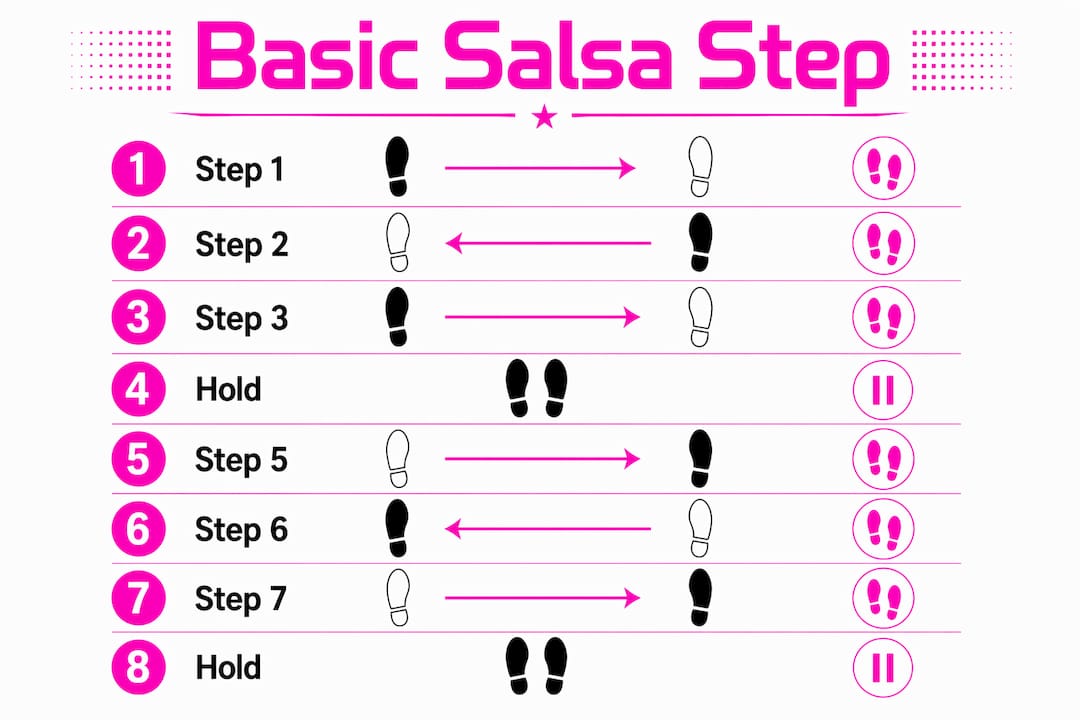
The basic salsa step is a forward-and-back weight transfer performed over an 8-count rhythm that forms the foundation of all salsa dancing. Formally called the “salsa basic,” it involves stepping forward, rocking back, and returning to center with precise pauses built into the pattern. Every turn, spin, and partner sequence you see on the dance floor grows directly from this one movement. Whether you want to learn salsa basics for social nights, fitness, or pure fun, this is where you start.
What is the basic salsa step, count by count?
The basic salsa step follows an 8-count phrase where you step on counts 1, 2, 3 and again on 5, 6, 7, with deliberate holds on counts 4 and 8. According to Ballroom Pages, in On1 timing, the leader steps the left foot forward on count 1, replaces weight onto the right foot on count 2, closes the left foot on count 3, and holds on count 4. Then the leader steps the right foot back on count 5, replaces weight onto the left foot on count 6, closes the right foot on count 7, and holds on count 8. That hold is not a mistake. It is a built-in pause that gives the step its characteristic rocking feel.
The follower mirrors this pattern. Leaders and followers move in opposition: when the leader steps forward, the follower steps back, creating the synchronized connection that makes partner salsa work.
Here is a side-by-side breakdown of the On1 basic step:
| Count | Leader | Follower |
|---|---|---|
| 1 | Left foot forward | Right foot back |
| 2 | Replace weight to right | Replace weight to left |
| 3 | Close left foot | Close right foot |
| 4 | Hold (no foot movement) | Hold (no foot movement) |
| 5 | Right foot back | Left foot forward |
| 6 | Replace weight to left | Replace weight to right |
| 7 | Close right foot | Close left foot |
| 8 | Hold (no foot movement) | Hold (no foot movement) |
Pro Tip: Count out loud while you practice. Saying “1, 2, 3, hold, 5, 6, 7, hold” keeps your brain and feet in sync far faster than counting silently.
Why weight shifting matters more than foot placement
Weight transfer is the core principle of beginner salsa footwork, not just where your feet land. Instructor Jean Franco Vergaray, cited by wikiHow, is direct on this point: the basic step is about shifting weight correctly and keeping your feet completely still during beats 4 and 8. Moving your feet during those pause beats is the single most common beginner mistake, and it throws off your entire timing.
Proper weight shifting also creates salsa’s signature hip movement. Salsa’s characteristic hip action comes naturally from shifting weight onto the ball of the foot. You do not force the hips to move. When your weight transfers fully onto one foot, that hip rises naturally. Trying to wiggle your hips separately looks forced and actually disrupts your timing.
Common beginner mistakes to watch for:
- Moving feet on the hold beats. Counts 4 and 8 are pauses. Your feet stay planted. Only your weight shifts.
- Stepping too wide. Large steps pull you off balance and make turns harder. Keep steps small and directly under your body.
- Partial weight transfer. If you do not fully commit your weight to each step, your hips stay flat and your timing gets muddy.
- Rushing the pattern. Salsa music moves fast. Beginners often skip the hold and start the next phrase early, losing the beat entirely.
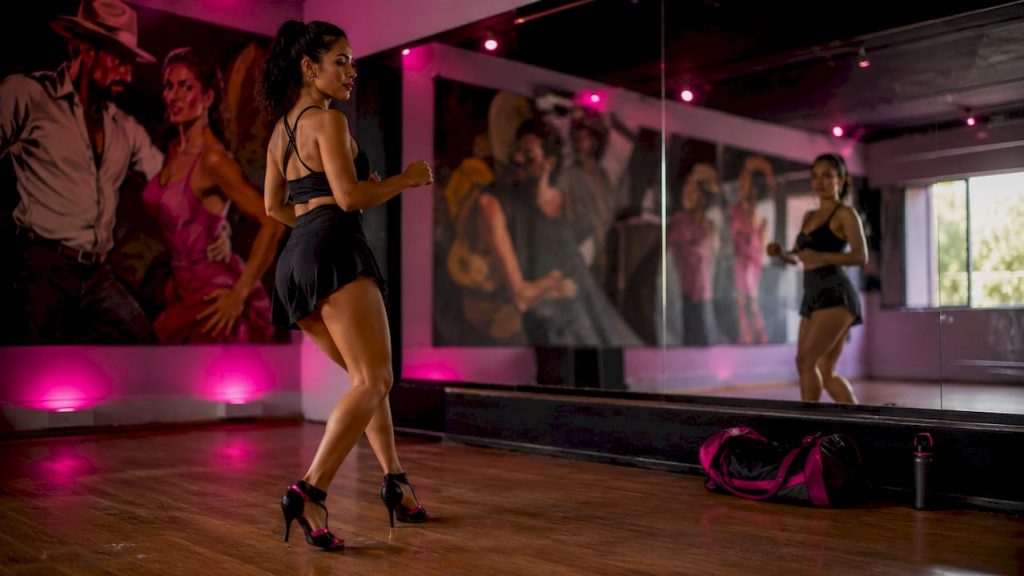
Pro Tip: Practice in front of a mirror and watch your hips. If they are not moving at all, your weight transfer is incomplete. If they are swinging wildly, you are forcing it. Natural, small hip movement is the goal.
On1 vs. on2: which timing style should you learn first?
Salsa timing styles differ by which beat you “break” on, meaning which beat carries the first weight change. On1 timing breaks on beats 1 and 5, while On2 timing breaks on beats 2 and 6. The foot pattern stays the same in both styles. What changes is when the forward or back step lands relative to the music.
Here is how the two styles compare:
| Feature | On1 (LA Style) | On2 (New York Style) |
|---|---|---|
| Break beat | Beat 1 and Beat 5 | Beat 2 and Beat 6 |
| Feel | Punchy, hits the downbeat | Smoother, syncopated |
| Common in | Los Angeles, Chicago, most beginner classes | New York, competitive circuits |
| Best for beginners? | Yes, easier to hear the beat | Better after On1 is solid |
On1 is the standard starting point for most beginners because the break lands on the most audible beat in salsa music. You hear the “1” clearly in most songs, which makes it easier to stay on time. On2 feels more musical to experienced dancers because it aligns with the conga drum pattern, but that subtlety is hard to hear when you are still counting steps.
The practical advice: learn the style your local instructor teaches or the one most common at your local social dance nights. Switching styles later is straightforward once your basic step is solid. Mixing styles mid-dance with a partner who is on a different timing, however, creates confusion. Match your community first.
How to practice the basic salsa step on your own
Solo practice is the fastest way to build beginner salsa footwork that holds up on a real dance floor. You do not need a partner to get good at the basic step. You need repetition, music, and a clear method.
Follow this practice sequence:
- Clap the beat first. Put on a salsa track and clap along to counts 1 through 8. Clapping the pattern before adding footwork helps your brain lock onto the rhythm without the distraction of moving your feet.
- Step without music. Count aloud: “1, 2, 3, hold, 5, 6, 7, hold.” Step through the pattern slowly until your feet know it automatically.
- Add music at slow tempo. Use a metronome app or find a slower salsa track. Step through the basic while counting aloud.
- Increase tempo gradually. Once you stay on beat at a slow tempo, bump the speed up. Do not rush this stage.
- Drop the counting. When the pattern feels automatic, stop counting and just listen to the music. Let the beat guide you.
Starting with small steps kept directly under your body is the single best technical habit you can build early. Small steps keep you balanced, make turns easier, and prevent the wide, lurching movement that throws off timing.
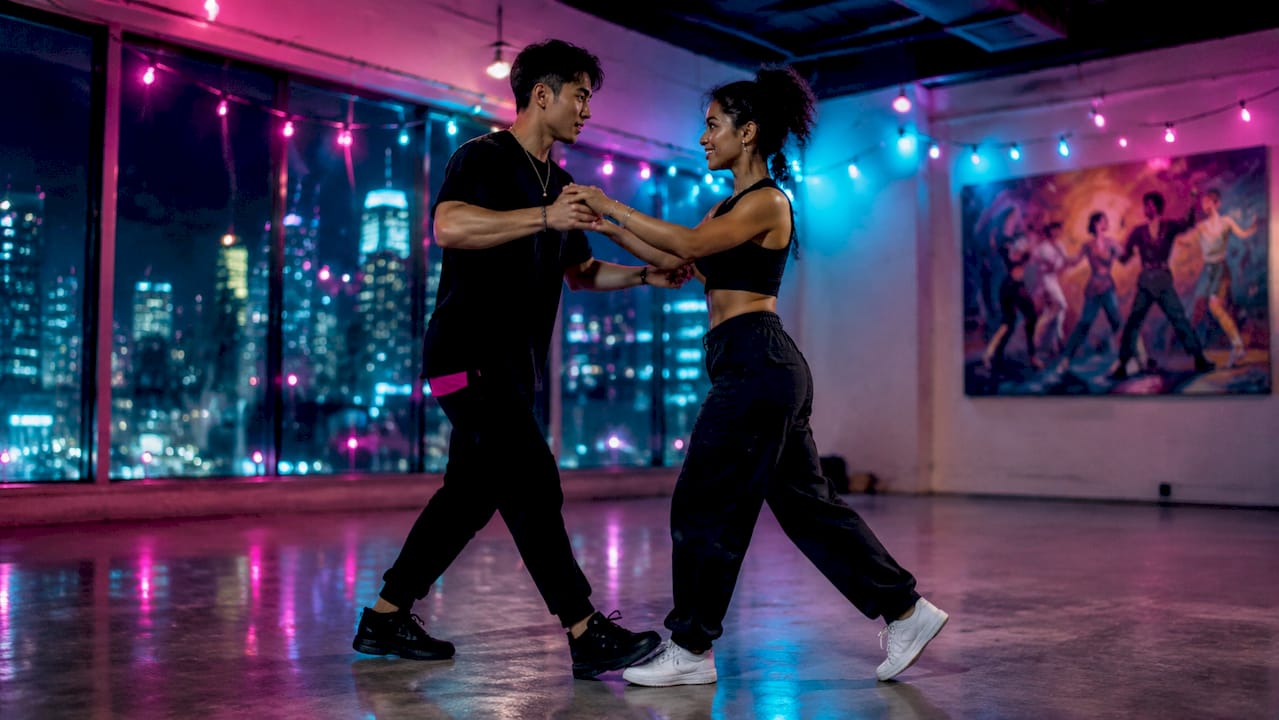
When you move to social dancing with a partner, the goal shifts slightly. A light, responsive frame in open hold allows the leader to communicate direction through subtle weight shifts rather than pulling or pushing. The follower responds to that pressure, not to visual cues. This connection starts with a reliable basic step on both sides.
Pro Tip: If you lose the beat mid-song, stop your feet completely for one measure. Listen for the “1” beat, then restart with a small basic step. Pausing briefly to find the beat before restarting prevents rushing and keeps your musicality intact.
The basic salsa steps explained here are also the foundation for turns, shines, and every partner sequence you will ever learn. Mastering this one pattern unlocks everything else.
Key takeaways
The basic salsa step is a weight-shifting, 8-count pattern where precise pauses on beats 4 and 8 create rhythm, hip movement, and the foundation for all advanced salsa technique.
| Point | Details |
|---|---|
| Core movement | Step on counts 1, 2, 3 and 5, 6, 7; hold completely still on counts 4 and 8. |
| Weight transfer first | Full weight commitment on each step creates natural hip movement without forcing it. |
| On1 for beginners | On1 timing breaks on the audible downbeat, making it the easiest starting point for new dancers. |
| Small steps win | Steps kept under the body improve balance, timing accuracy, and turn readiness. |
| Solo practice works | Clapping, counting, and stepping solo with music builds timing faster than jumping straight to partner work. |
What 33 years on the floor taught me about the basic step
After more than three decades teaching salsa in Chicago, I can tell you the basic step is where most beginners either build a real foundation or develop habits that slow them down for years. The students who progress fastest are not the ones with natural rhythm. They are the ones who take the basic step seriously enough to practice it until it is boring.
Here is what I see constantly: beginners want to skip ahead to turns and flashy footwork before their weight transfer is clean. The result is turns that spin out of control and partner connections that feel like a tug-of-war. When you go back and fix the basic, everything else clicks into place almost immediately.
The pause beats are where most of the magic happens, and most beginners rush right past them. Counts 4 and 8 are not dead space. They are where you absorb the music, reset your balance, and communicate with your partner. Respecting those pauses is what separates dancers who look musical from dancers who just look busy.
One more thing: you do not need a partner to get good. Solo practice with music is genuinely effective. Some of my strongest social dancers spent their first month practicing alone in their living rooms. The common beginner mistakes I see most often come from skipping that solo phase and relying on a partner to carry the timing.
Salsa is also one of the best workouts you will find that does not feel like exercise. Once the basic step is in your body, you stop thinking and start feeling the music. That is when it becomes genuinely fun.
— Dennis pasamba
Ready to take your first real salsa class in chicago?
Reading about the basic step gets you started. Dancing it with great music and an experienced instructor gets you there fast. Dennis pasamba is Chicago’s top-rated Latin dance studio with over 850 five-star reviews and 33 years of teaching experience. No partner needed. Singles and couples are both welcome.
Whether you want beginner evening classes that fit your schedule or a private one-on-one lesson to get your footwork dialed in quickly, Dennis pasamba has the right option for you. Before you sign up, check out the studio checklist for beginners to know exactly what to look for and what to expect. New classes are starting now in Chicago. Come join the fun.
FAQ
What is the basic salsa step in simple terms?
The basic salsa step is a forward-and-back rocking movement performed over 8 counts, with steps on counts 1, 2, 3 and 5, 6, 7 and holds on counts 4 and 8. It is the foundational pattern for all salsa dancing.
Do i need a partner to learn the basic salsa step?
No partner is needed to learn the basic step. Solo practice with music or a metronome is one of the most effective ways to build timing and foot coordination before dancing with someone else.
What is the difference between on1 and on2 salsa timing?
On1 timing breaks on beats 1 and 5, while On2 timing breaks on beats 2 and 6. Beginners should start with On1 because the break lands on the most audible downbeat in salsa music.
Why do my hips not move when i do the basic step?
Flat hips usually mean incomplete weight transfer. When you fully shift your weight onto one foot through the ball of the foot, the hip on that side rises naturally without any extra effort.
How long does it take to learn the basic salsa step?
Most beginners can execute a clean basic step within one to three practice sessions. Internalizing it well enough to stay on beat with music typically takes one to two weeks of consistent daily practice.