
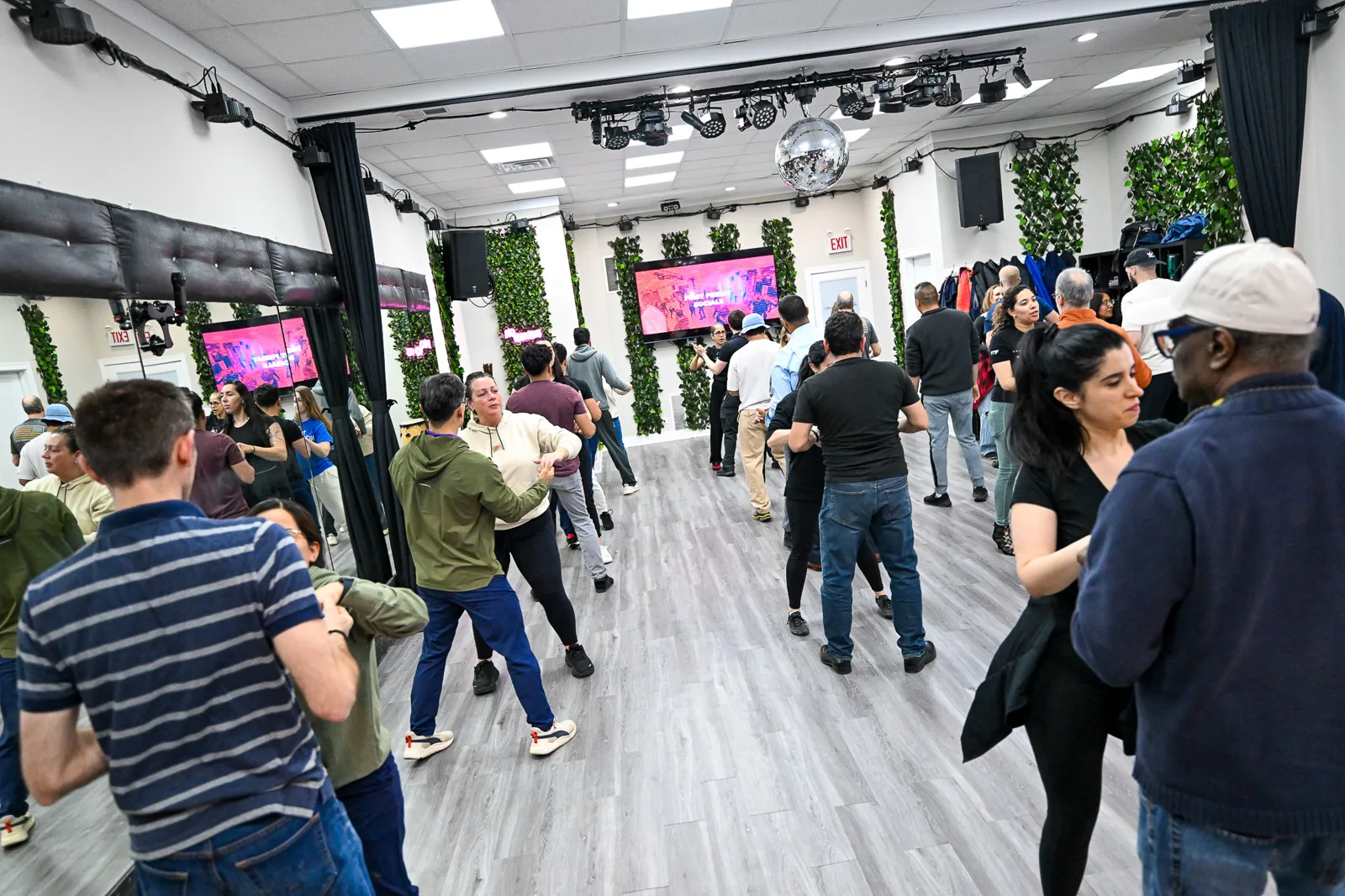
How Does Complex Salsa Partnerwork Work as an Active Brain Training Exercise?
Complex salsa partnerwork requires your brain to process multiple streams of information at once. You must listen to the music, track your partner's position, and execute precise physical movements simultaneously. This heavy mental workload forces your brain to build new neural pathways. By practicing detailed turn patterns on a regular basis, you give your mind a rigorous workout that builds strong cognitive resilience and improves daily mental focus over time.
Spatial awareness is a major component of cognitive health that salsa sharpens very quickly. As you lead or follow intricate combinations, your brain constantly calculates physical distances and direction changes. You must anticipate where you and your partner will move next within a shared space. This continuous spatial processing trains your mind to assess environments faster, boosting your visual-spatial reasoning and overall mental alertness both on and off the dance floor.
Memory recall plays a central role in mastering complex salsa dance routines. Dancers must store sequences of footwork, hand connections, and weight shifts in their short-term memory during practice. Repeating these sequences transfers the movements into muscle memory over time. This continuous cycle of learning, storing, and retrieving complex movement patterns keeps your memory sharp and encourages lifelong neuroplasticity through highly enjoyable physical movement.
Rapid decision-making is necessary whenever you navigate lead-and-follow dynamics in salsa partnerwork. Leads must choose the next move based on timing and space, while followers must react instantly to physical cues. There is no time to overthink while keeping beat with fast Latin rhythms. This instant feedback loop trains your executive function, helping your brain process unexpected changes quickly and stay calm under pressure in everyday life.
Rhythm and musical timing add another deep layer of cognitive engagement during salsa dancing. Your brain must decipher complex syncopated Latin rhythms while directing your body to step accurately on specific beats. Coordinating hand signals, body balance, and foot placement to musical cues challenges your motor cortex and auditory system simultaneously. This combined effort builds stronger neural connections between auditory processing and physical motor coordination.
Social interaction combined with physical touch amplifies the brain training benefits of partnerwork. Communicating without words requires deep focus, active listening, and emotional presence with another person. Your brain actively reads subtle physical tension, hand pressure, and body language cues in real time. This rich sensory environment stimulates multiple brain regions at once, providing a well-rounded mental workout that solo exercise routines simply cannot match.
You can experience these amazing brain-boosting benefits at Dennis PaSamba Dance Company in Chicago. Our studio is located at 4820 W. Irving Park Rd. in the Irving Park and Six Corners neighborhood, offering free parking for your convenience. We provide a supportive environment to challenge your mind through step-by-step partnerwork instruction. Text or call 717-PaSamba to learn more about joining our upcoming salsa sessions.
Questions people ask
How does learning complex salsa turn patterns exercise the brain?
Salsa turn patterns challenge your working memory and spatial problem-solving skills in real time. Your brain must remember multi-step sequences while adapting to your partner's movement and the speed of the music. This multi-tasking environment stimulates neuroplasticity and strengthens cognitive endurance.
Can beginners get brain training benefits from salsa partnerwork?
Yes, beginners receive immense brain training benefits because everything is fresh and challenging to the mind. Learning basic footwork and fundamental partner connections creates brand new neural pathways. As you progress to complex moves, your brain continuously adapts to new cognitive challenges.
How do I get started with salsa partnerwork at Dennis PaSamba Dance Company?
Getting started is simple and friendly for everyone. You can visit us at 4820 W. Irving Park Rd. in Chicago with easy free parking available. To get details on class options and schedules, please text or call 717-PaSamba today.
Visit the studio
Dennis PaSamba Dance Company
4820 W. Irving Park Rd., Chicago, IL 60641
Six Corners · Portage Park · Irving Park
dennispasamba.com · Text/Call 717-PASAMBA ((717) 727-2622)