
How Can You Master Finding the Clave Rhythm in Salsa On2 Music?
The clave is the rhythmic foundation of salsa music, usually played on two wooden sticks called claves. In Salsa On2, also known as Mambo timing, understanding the clave helps you pinpoint key counts like the two and six. The two main clave patterns are the 2-3 clave and the 3-2 clave. Listening specifically for the two distinct wooden strikes or the three quick strikes builds a solid mental map for your dance steps.
To start training your ear, focus on isolating the wooden sound from the rest of the orchestra. Turn off distractions and listen to classic salsa tracks where the percussion instruments stand out clearly. Try tapping your hand on your leg whenever you hear the wooden sticks hit together. At first, you might lose the pattern when brass sections get loud, but repeated listening helps your brain filter out background noise over time.
Connecting the clave to your On2 footwork requires aligning your break step on count two with the musical accent. In a 2-3 clave pattern, the first two strikes fall directly on key beats that support breaking on two. When you hear that distinct rhythm, your feet naturally want to move on the correct count. Practicing slow steps while listening to isolated clave tracks makes this connection permanent in your body memory.
The conga drum also offers major clues that help you locate the clave in Salsa On2. Listen for the conga open tones, which frequently hit on counts four and eight, alongside the slap on beat two. Because the conga and the clave work tightly together, hearing the conga slap gives you an immediate cue for where the clave rests. This multi-instrument awareness speeds up your ability to find timing during social dances.
If you struggle to hear the wooden sticks, listen to the bass line or the piano montuno for help. Salsa musicians weave their parts directly around the clave structure, so every instrument reflects the pattern. The piano accents and bass tumbao constantly reference the clave pulse. Once you understand how these supporting instruments interact with the underlying rhythm, finding the On2 timing becomes much easier even on tracks where the actual clave is quiet.
Regular practice in a structured group environment accelerates your ability to hear the music accurately. At Dennis PaSamba Dance Company, we guide students through musicality exercises designed to sharpen your ear. Our group classes are $95 for 4 weeks of instruction at 4820 W. Irving Park Rd. in Chicago. We are located in the Irving Park neighborhood near Six Corners, and we offer free parking for all of our students.
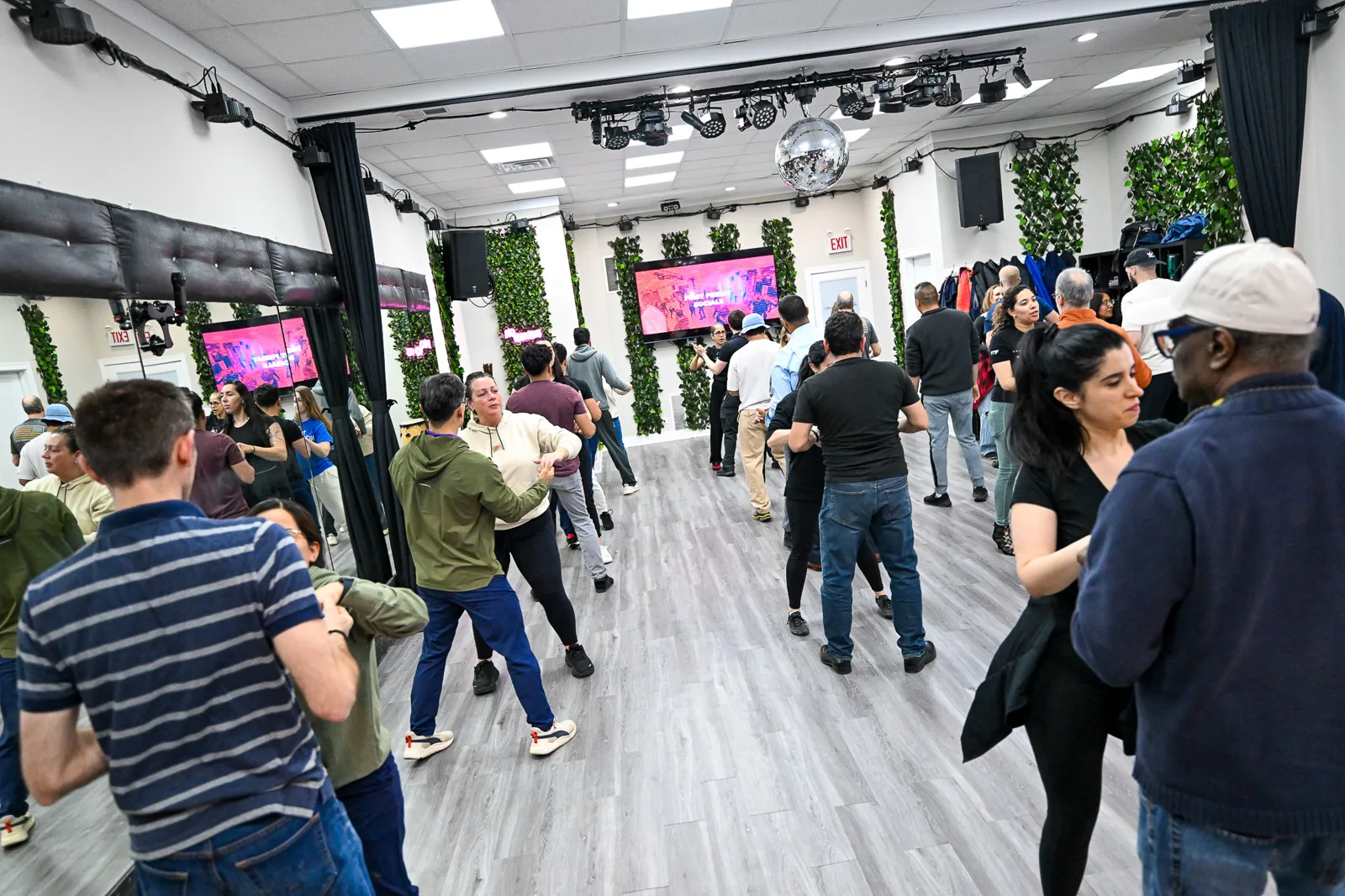
Dancing with different partners while listening to the beat reinforces your internal rhythm. In our classes, no partner is needed because partners rotate continuously throughout the lesson. This constant rotation forces you to rely on your own timing and your understanding of the clave, rather than leaning on a partner. If you want to join our next session, text or call 717-PaSamba to get started with our friendly dance community.
Questions people ask
What is the difference between a 2-3 clave and a 3-2 clave in Salsa On2?
A 2-3 clave starts with two beats in the first measure followed by three beats in the second measure, while a 3-2 clave reverses this order. In Salsa On2, dancers step on the two count regardless of which measure comes first. Learning to spot which measure starts the song helps you feel the flow of the music.
Why is it hard to hear the clave in modern salsa songs?
Modern salsa tracks often submerge the actual wooden clave sound under heavy brass arrangements, electric instruments, or dense vocals. Even if the physical sticks are not playing loudly, the rest of the band still plays in reference to the clave pattern. Training your ear on older, acoustic salsa records helps you identify the hidden clave in complex modern songs.
How can I practice finding the On2 beat at home?
You can practice at home by listening to salsa songs while clapping only on the two and six counts. Try counting out loud from one to eight while tapping your foot every time the clave plays its accent. Repeating this simple exercise daily builds strong muscle memory and sharpens your musical timing before hitting the dance floor.
Visit the studio
Dennis PaSamba Dance Company
4820 W. Irving Park Rd., Chicago, IL 60641
Six Corners · Portage Park · Irving Park
dennispasamba.com · Text/Call 717-PASAMBA ((717) 727-2622)