
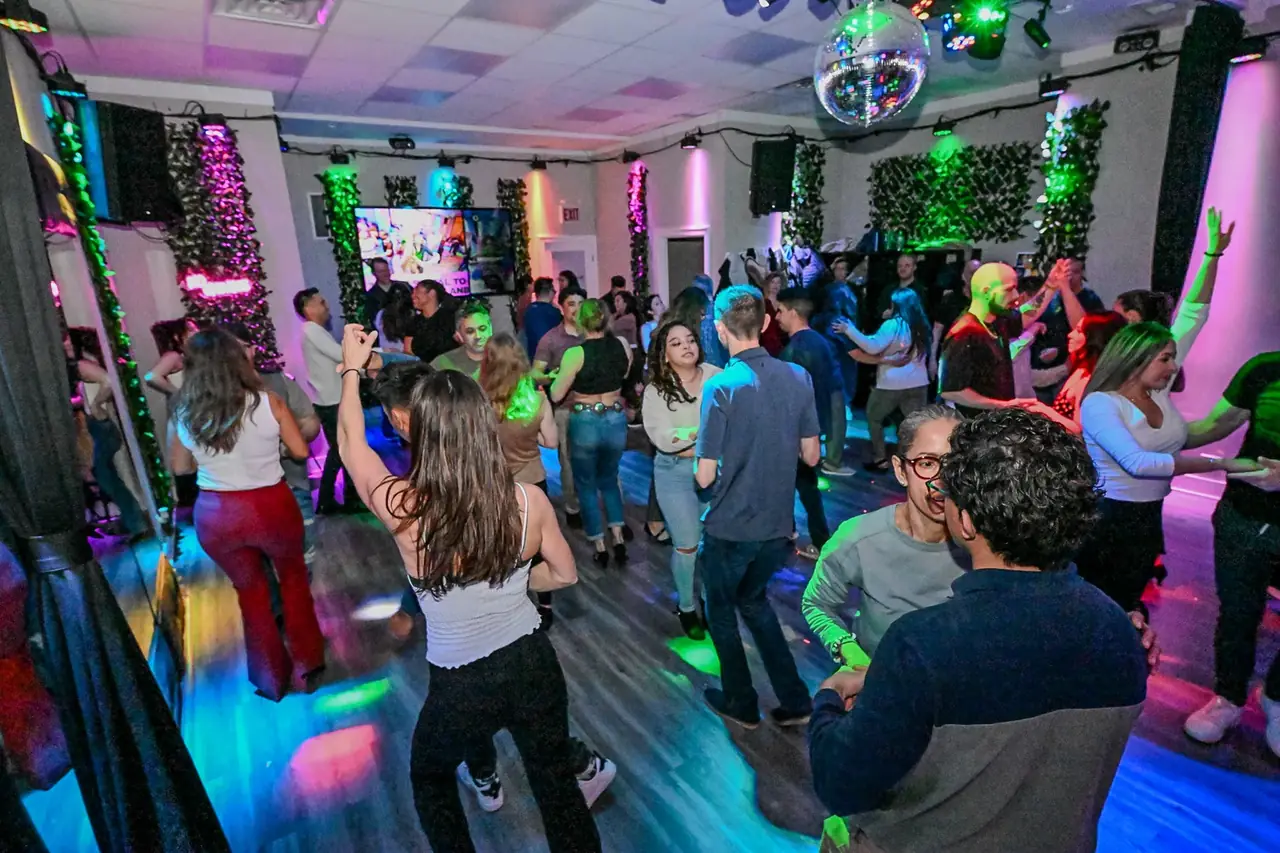
Bachata stays in place
The bachata basic moves side to side within a small space. You and your partner stay close, and the focus is on connection and the tap on 4.
Cumbia travels
Cumbia uses a back step and a circular feel that carries couples around the floor. It has a bouncy rhythm and plenty of room for spins.
Try both
Because one stays put and the other moves, learning both gives you a wider range at a social. Add a second style for $55.
Bachata: The Dance of Intimacy and Rhythm
Bachata originated in the Dominican Republic. It grew from a guitar-based folk music. The dance is known for its sensual movements. It emphasizes close partner connection. Dancers move side to side, usually in a 4-count pattern. A distinct hip movement and a 'tap' on the fourth beat mark the style. This tap can be a small lift of the foot or a gentle hip sway. Basic steps are small and contained. This allows for intricate footwork and body isolations in a compact space. The music is often romantic and melancholic. This lends itself to expressive partner work. Bachata is a popular social dance worldwide. There are several styles of bachata. These include traditional, modern, sensual, and fusion. Each style offers unique interpretations of the dance's core elements. Learning bachata helps develop lead-follow communication. It enhances musicality and rhythmic interpretation. It is a fantastic dance for building confidence on the dance floor. Many dancers appreciate its emotional depth and lyrical storytelling.
Cumbia: The Joyful, Traveling Beat
Cumbia hails from Colombia, with African, Indigenous, and European roots. It's a vibrant and energetic dance. The rhythm is distinct and very catchy. Cumbia's basic step involves a back-and-forth motion. Dancers often travel around the floor in a circular pattern. The dance has a characteristic bounce or 'skip' in its step. This gives it a lighthearted and joyful feel. Cumbia music is often played with accordions, drums, and flutes. The tempo can vary, from slow and romantic to fast and celebratory. Unlike bachata, cumbia allows for more space between partners. This facilitates spins, turns, and more expansive movements. It's a dance that encourages improvisation and personal flair. Cumbia is celebrated across Latin America and beyond. Learning cumbia introduces you to a rich cultural heritage. It's an excellent way to improve your sense of rhythm. It also helps with floorcraft and navigating social dance spaces. The lively music is infectious and invites everyone to move.
Choosing Your Path: Bachata or Cumbia?
The choice between bachata and cumbia depends on your preference. Do you enjoy close connection and intricate footwork? Bachata might be your first love. Are you drawn to joyful movement and traveling across the dance floor? Cumbia could be your perfect match. Both dances offer unique benefits. Bachata refines your partner communication in a tight space. Cumbia builds confidence in moving with the music. Our group classes are 4-week sessions for $95. No partner is needed, and partners rotate. All classes are for adults. Missed weeks can be made up. There are no refunds. We are located at 4820 W. Irving Park Rd., Chicago, IL 60641, in Six Corners. We offer free parking. Text or call 717-PaSamba (717-727-2622) to learn more. Consider trying both styles. This expands your dance repertoire. It makes you a more versatile dancer at any social event. You can add a second style for only $55. Friday Socials are practice opportunities for $15.
Questions people ask
Where can I learn cumbia?
Our cumbia classes page lists the 4-week cumbia course.
What is the typical music for Bachata?
Bachata music is typically guitar-driven. It often features a distinct bass line and bongo drums. It's usually romantic and can be slow or upbeat.
What's the difference in hold between Bachata and Cumbia?
Bachata often uses a close embrace or open hold with partners quite near each other. Cumbia often features a more open hold, allowing for more expansive arm and body movements.
Visit the studio
Dennis PaSamba Dance Company
4820 W. Irving Park Rd., Chicago, IL 60641
Six Corners · Portage Park · Irving Park
dennispasamba.com · Text/Call 717-PASAMBA ((717) 727-2622)