
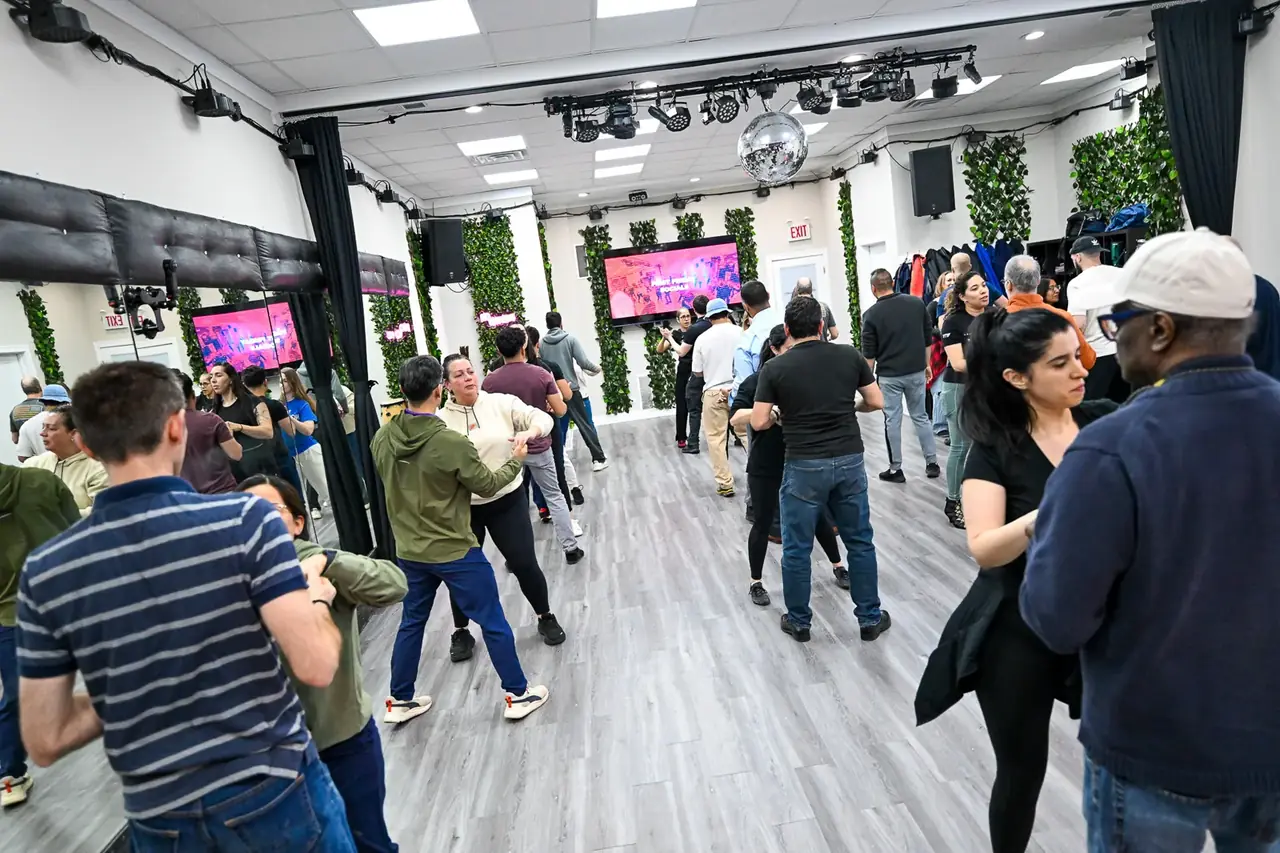
How Do You Choose A Visual Spot During Dance Turns?
Start with a target that stays still. A mark on a wall, a fixed sign, or a detail on a door can work well. Avoid another dancer, a swinging decoration, or anything that may shift while you move. Your spot gives your eyes a familiar place to return to during the turn. If the target moves, you have to track it instead of returning to one clear reference.
Look for a spot close to your natural eye level when you stand in your dance posture. You should be able to see it without lifting your chin or dropping your gaze. A ceiling light or floor mark may be easy to notice, but either can draw your head away from a comfortable position. Choose a point that lets your eyes look forward while your neck stays relaxed and your head remains comfortably upright.
Make the target specific enough that you know exactly where to look. An entire wall is too broad to offer a clear return point. A corner of a poster or a small contrasting feature is more useful. You do not need to study tiny lettering or strain to make out a detail. The goal is a recognizable point, not a reading task. Choose something you can identify quickly with your usual vision correction, if needed.
Distance matters because a target that is very close can be awkward to keep finding as your position shifts. For practice, try a clear point on a wall across the room rather than something immediately beside you. There is no single distance that suits every room or dancer. Test the choice with a slow turn. If you have to angle your head sharply or search around nearby objects, select a more comfortably placed target.
Check what surrounds your chosen spot. A small mark may seem clear while you are standing still, then disappear against a busy mural or a crowded mirror reflection. Look for contrast, such as a dark feature on a light wall. Avoid lights that glare into your eyes and screens with changing images. You want a target that remains easy to recognize when you return to it, without squinting or sorting through several similar details.
A mirror can offer a useful practice reference, but choose carefully. Your own reflection moves, and other dancers may cross behind it. A fixed detail on the mirror frame can be easier to locate than a face in the reflection. If you use your reflection under a teacher's guidance, keep the chosen reference clear. When the reflection becomes distracting, switch to a stationary feature outside the mirror and compare how easily you find it.
Match the spot to the direction and purpose of the turn you are practicing. For a turn that finishes facing the same way, a fixed point ahead is a simple starting choice. Traveling turns or changes of facing may need a different reference, so ask your teacher where your gaze should return. At Dennis PaSamba Dance Company, you can ask about choosing a target for your dance. Text 717-PaSamba for details.
Questions people ask
Should I choose a new visual spot for every turn?
For repeated turns that return to the same facing, keeping one stationary spot can make the reference easier to find. If the choreography changes your facing or path, your target may need to change too. Choose the reference that fits the turn rather than holding onto a spot behind your intended direction.
Can I use my partner as my visual spot?
A moving partner is usually less reliable than a fixed feature when you are practicing a stationary spotting reference. Some partnered movements call for a particular gaze or connection, so follow your teacher's guidance for that movement. For basic solo practice, start with a stationary point.
What if my chosen spot becomes blurry during the turn?
Choose a larger, clearer feature with good contrast rather than trying harder to read a tiny detail. Your target should be easy to recognize when your gaze returns, not necessarily clear throughout the rotation. If you feel dizzy or unwell, pause instead of continuing to test different spots.
Visit the studio
Dennis PaSamba Dance Company
4820 W. Irving Park Rd, Chicago, IL 60641
Six Corners · Portage Park · Irving Park
dennispasamba.com · Text/Call 717-727-2622 (717-727-2622)